
Best Foldable Electric Wheelchairs UK (2026): Heavy Duty, 25 Stone+ & Honest Reviews
Last updated: May 2026: Best Foldable Electric Wheelchairs UK (2026)
After being stuck at home with a transit wheelchair from NHS Wheelchair Services that I couldn’t operate myself, I went on a deep dive into foldable electric wheelchairs. I bought my own, the KWK D09, I’ve travelled the world in it, and I’ve recommended chairs to so many readers over the years that it felt time to properly update this guide. Especially now I’ve had a massive upgrade to a Robooter E60 Pro.
Read my full honest review of the Robooter E60 Pro.
This post is for anyone who already knows a foldable electric wheelchair is the right choice for them and wants an honest breakdown of what’s actually worth buying in the UK in 2026, especially if you’re plus size, heavier than the average chair caters for, or just sick of being told that “multi-terrain” means anything at all.

Quick Pick Comparison: Best Foldable Electric Wheelchairs UK 2026
| Wheelchair | Max User Weight | Seat Width | Frame Weight | Price (from) | Best For |
| KWK D09 XL | 28 stone (180kg) | 21″ | 25kg (no battery) | £2,145 (cheapest from Sheffield Mobility) | Quality heavy duty |
| Robooter E60 Pro | 23.5 stone (150kg) | 20″ | ~36kg (no battery) | ~£3,795 | Genuine all-terrain with omni wheels |
| MX-MAX Multi Terrain | 28 stone (180kg) | 20.5″ | 25kg (no battery) | £1,399 | Budget heavy-duty (NOT off-road) |
| MobilityPlus+ RangerXL | 25 stone (160kg) | 20″ | 26kg (no battery) | £839.99 | Best budget heavy-duty |
| Etech Freedom Pro ST | 25 stone (160kg) | 20.5″ | 26kg (no battery) | £845.50 | Budget heavy-duty alternative |
| Freedom Chair A08L/DE08L | 25 stone (160kg) | 19″ | 28.5kg (no battery) | £2,290+ | Well-known brand |
| MobilityPlus+ Ultra-Light | 19 stone (120kg) | 17″ | 24kg (no battery) | £769.99 | Best budget all-rounder |
| Pride i-Go | 18 stone (120kg) | 17.5″ | 19.8kg (no batteries) | £1,559 | Well-known brand |
Mobile phone version:

A note on seat widths: Most of these folding electric wheelchair styles with the folding-arm mechanism can have washers added to the sides of the armrests to gain around 5cm (2″) of extra space, and that’s actually exactly what happens on most “XL” versions. They’re often the same chair frame with washers/spacers fitted as standard. If you’re between sizes, or worried a chair will feel too narrow, ring the retailer and ask whether washers can be added to widen the armrests. It’s a much cheaper fix than buying a different model, and many mobility shops will do it for you. Some, like the Freedom Chair range, sell official widening kits in 2.5″ or 4″ sizes.
Prices change constantly, please double check before you buy. I don’t update this monthly.
Don’t Forget VAT Relief When Buying a Wheelchair
Before we get into chairs, one thing every foldable electric wheelchair shopper in the UK should know: you can usually buy your chair VAT-free.
If you have a long-term illness or disability that significantly affects your daily life, HMRC’s VAT Relief scheme means you don’t pay the 20% VAT on mobility equipment bought for personal use. You don’t need to be registered disabled or claiming benefits, you just sign a short declaration at checkout. Conditions like arthritis, MS, EDS, fibromyalgia, chronic pain conditions, stroke, Parkinson’s, ME/CFS and many more typically qualify, as long as the condition is long-term (12+ months) and meaningfully affects your mobility.
Most reputable mobility retailers handle this automatically. On a £2,145 chair like the KWK D09, that’s £429 saved. On the Robooter E60 Pro, you’re looking at savings of £750+. Always ask if it’s not obviously offered.
The prices I’ve listed in this post are mostly the VAT-relief prices (where retailers list them that way), but always double check at checkout.
The Truth About “All-Terrain” Folding Electric Wheelchairs
This is the bit I wish someone had told me earlier, and honestly, it’s the reason I’m rewriting this post.
Almost every folding electric wheelchair sold in the UK is NOT actually all-terrain, no matter what the listing or model name says. “Multi-terrain”, “all-terrain”, “off-road”, these words get slapped on chairs that, in reality, can handle smooth pavement, the odd dropped kerb, and gentle gradients. That’s it.
The reason is simple: most folding powerchairs use small, standard front castor wheels. Castors swing around to change direction, which means they get stuck on uneven ground, snag on cobbles, dig into grass, and tip you forward on rough surfaces. A bigger battery or a name with “Multi Terrain” in it doesn’t change the physics.
The Exception: Omni Wheels
There is currently one folding electric wheelchair in the UK that I’d genuinely call all-terrain, the Robooter E60 Pro, which I now own and have been putting through its paces.
Instead of standard castors, it uses omni wheels: fixed-forward front wheels made up of smaller side wheels that roll left and right when you turn. Because the front wheels don’t swing, the chair stays stable, the suspension can be much chunkier, and you can actually take on uneven terrain, gravel paths, grass, and kerbs of around 8cm without drama.
Standard Folding Wheelchairs vs Omni Wheel Folding Wheelchairs
Here’s what the difference actually means in real life:
| Feature | Standard Folding Powerchair (e.g. KWK D09) | Omni Wheel Folding Powerchair (Robooter E60 Pro) |
| Front wheels | Small castors that swing to turn | Fixed-forward omni wheels with side rollers |
| Smooth pavement | Excellent | Excellent |
| Cracked pavement / dropped kerbs | Manageable | Effortless |
| Cambered pavements (sloped to drain) | Chair can drift sideways into the road | Stays planted |
| Cobbles | Castors can stick and jolt | Glides over |
| Grass / parks | Bogs down, castors dig in | Designed for outdoor use |
| Gravel paths | Castors get stuck | Designed for it |
| Kerb height | Around 3–4cm max | Up to 8cm |
| Suspension | Minimal or none | Dual suspension |
| Turning in tight spaces | Castors must swing round first | Turns on the spot – no swing |
| Stability on uneven ground | Tippy, especially at the front | Sturdy, planted feel |
| Weight limit options | Up to 28 stone (180kg) | 23.5 stone (150kg) max |
| Price | From around £800 | From around £3,795 + VAT |
Mobile phone version:

The omni wheel design is genuinely a different category of chair, not just a fancier version of the same thing. If you mostly use your chair on pavement and shop floors, a standard folder is fine and will save you thousands. If you want to go to parks, castles, gardens, woodland paths, country pubs, festivals, anywhere with surfaces that aren’t perfectly smooth, omni wheels change what’s possible.
The big catch for plus-size readers: the Robooter caps out at 150kg / 23.5 stone, which is lower than several of the heavy-duty folders. If you need more capacity, you currently have to choose between weight limit and genuine terrain capability, there’s no folding chair on the UK market that gives you both.
If a folding chair listing says “all-terrain” and doesn’t mention omni wheels, treat that claim with serious suspicion.
Why I Love Foldable Electric Wheelchairs (Honest Version)
Now that the terrain bit is out of the way, here’s why this style of chair changed my life, these are things that apply to both my KWK D09 and the Robooter:
- Fits in any car boot with no extra equipment (as long as someone can lift it for you, the Robooter is 36kg so you do have to be very strong, have two people to lift, or use a hoist)
- Flight-safe with airline-approved battery options
- Long battery life that easily handles a full day out
- Simple maintenance you can do yourself
- Genuinely comfortable for longer outings
- I’ve travelled the world in them!
What’s different between them in real use:
- My KWK D09 is a reliable everyday chair for shopping, city days, travel and flat pavement use. It’s lighter, simpler, and at 28 stone weight capacity, it’s genuinely done well.
- My Robooter E60 Pro is my new day-to-day for off pavement, parks, gardens, slightly rough surfaces, places I’d have previously got stuck or struggled in. I also don’t need someone to hold the back of my chair whilst I’m on uneven pavement so I don’t go into the road.
If anything, my only regret is not finding this style of chair sooner.
Wheelchair Adaptations
These types of foldable electric wheelchairs are quite simple in design. If you need specialist adaptations like headrests, elevating leg rests, or custom seating, you would be better off going through NHS Wheelchair Services, where they can fully customise chairs for you.
This post is mainly for people who already know that a foldable electric wheelchair is the best choice for them and who want to find an affordable option.
Shopping for the Best Foldable Electric Wheelchairs
Heavy Duty Foldable Electric Wheelchairs (Over 25 Stone Capacity)
KWK D09 XL Folding Powerchair (My First Chair)
- Max user weight: 28 stone (180kg)
- Seat width: 21″ (XL version) – comes widened as standard
- Frame weight: 25kg without batteries
- Weight: 25kg without batteries
- Price: £2,145
- Buy from: Sheffield Mobility (cheapest place online)
This was the chair that gave me my independence back, and it’s still the one I’d recommend to most plus size readers as their first foldable electric wheelchair. Sheffield Mobility happen to be the cheapest online and they’re local to me.
It’s a quality heavy duty chair, not all-terrain, but for the weight capacity, comfort, and price, nothing in the heavy duty folding space comes close.
One honest caveat from my own experience: even on standard pavement, I’ve found the KWK can slip into the road on cambered pavements (where the pavement slopes down towards the kerb to drain water). It’s something to be aware of if you live somewhere with a lot of sloped pavements. It’s still a fantastic chair, but no folding chair without omni wheels handles cambers brilliantly, and this one is no exception.
My previous wheelchair is the KWK D09 XL version from Sheffield mobility, pictured below.


MX-MAX Multi Terrain
- Max user weight: 29 stone (185kg)
- Seat width: 18″ (46cm) standard, or 20.5″ (52cm) with widening kit
- Frame weight: 25kg without battery
- Price: £1,399
- Buy from: Mobility Extra
The price is appealing and the weight limit is great, but don’t be fooled by the “Multi Terrain” name. I can’t see anything in the spec that would let it actually handle off-road use. Treat it as a budget heavy-duty pavement chair, not something to take on rough ground. The widening kit option is a nice touch for plus size users.
Freedom Chair A08L / DE08L
- Max user weight: 25 stone (160kg)
- Seat width: listings vary – manufacturer (e-goes) lists the A08 series at 19″; some retailer listings show 17.5″. Always confirm with the retailer before buying.
- Widening kit available – adds 2.5″ or 4″ between the armrests
- Frame weight: 28.5kg without battery
- Price: £2,290–£2,799
- Buy from: e-goes Mobility
Premium folding chair with a solid reputation. The seat width situation is genuinely confusing across UK retailers, so always ring and confirm before buying, and ask specifically about the widening kit if you need extra space. Honestly, I’d treat the manufacturer’s 19″ figure as the more reliable one given inconsistencies in retailer listings.
MobilityPlus+ Ultra-Light RangerXL
- Max user weight: 25 stone (160kg) – They also do a 28.5 Stone version called the MobilityPlus+ FortisHD
- Seat width: 18″ (46cm), expandable by ~2″ with included armrest spacers
- Frame weight: 26kg without battery
- Price: £839.99
- Buy from: MobilityPlus+
I’ve sent loads of readers to MobilityPlus+ over the years for their lighter chair, so seeing them offer a heavy duty option at this price is brilliant. Best budget heavy duty pick if you’re on the lower end of the 25 stone limit.
Etech Freedom Pro ST
- Max user weight: 25 stone (160kg)
- Seat width: standard or wide-seat option at 20.5″ (52cm) between armrests
- Frame weight: 26kg without battery
- Price: £845.50
- Buy from: Etech Mobility
Another really affordable option in the same bracket as the RangerXL. Worth specifically asking about the wide-seat version if you need more room, it’s listed separately on their site.
A Note on Higher Weight Capacities (Over 28 Stone)
There is one UK brand making a folding electric wheelchair with capacity up to 47 stone (300kg), which on paper is a brilliant option for anyone who needs more than the KWK D09’s 28 stone limit. However, I won’t be naming or linking to them in this post.
All-Terrain Foldable Electric Wheelchair (Up to 23.5 Stone Capacity)
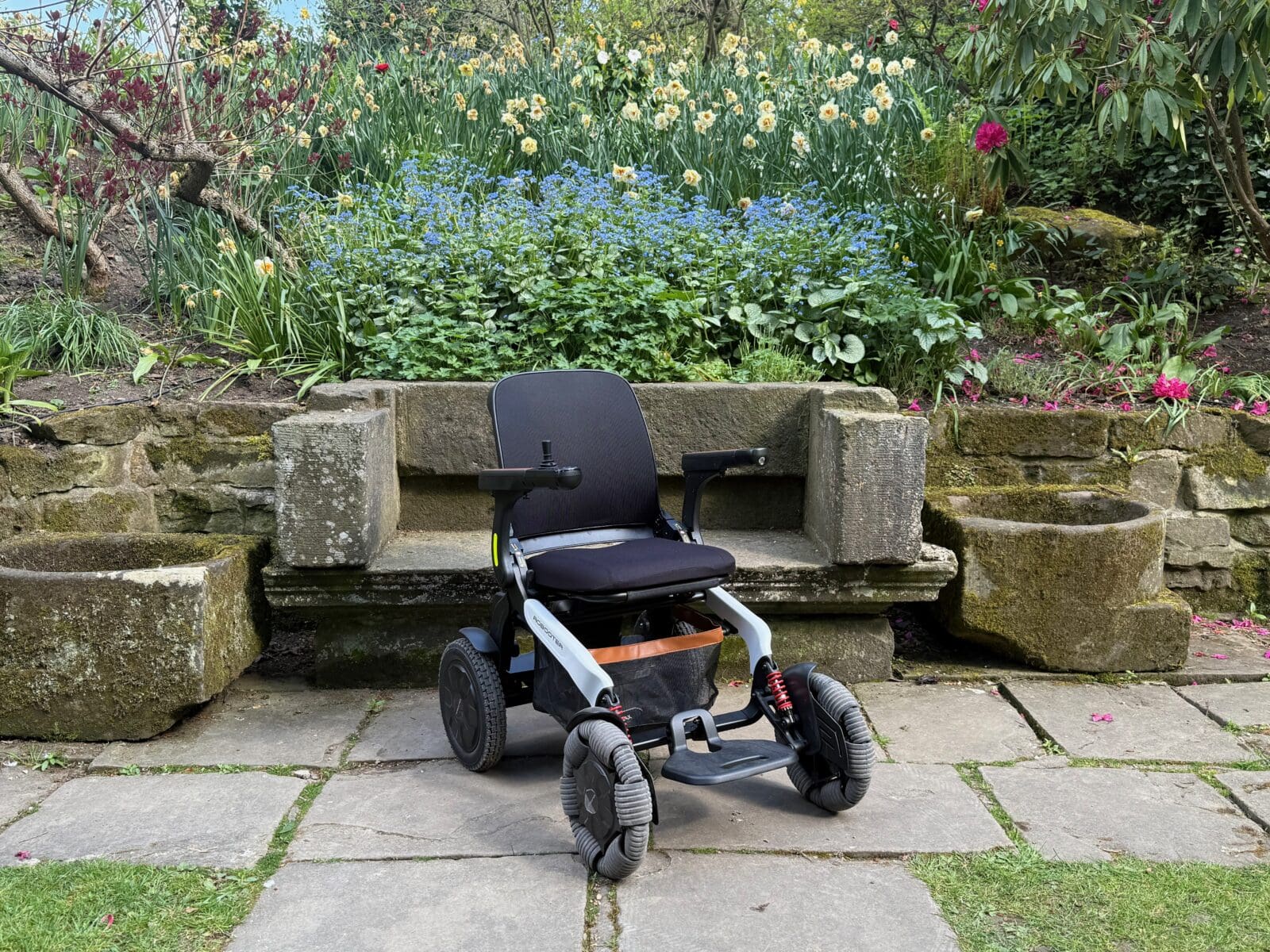
Robooter E60 Pro (My Current Chair)
- Max user weight: 23.5 stone (150kg)
- Seat width: 20″ (adjustable 45.5–51.5cm between armrests)
- Frame weight: ~36kg without battery
- Price: from around £3,795 + VAT
- Buy from: Contact Proactive Mobility, the official UK importer for Robooter, and they’ll put you in touch with an authorised distributor near you. This is also the best way to arrange a demo or try the chair in person before buying.
This is the chair I now reach for when I want to go anywhere off pavement, parks, gardens, slightly rough surfaces, places I’d previously have had to skip or get pushed. It’s the only folding electric wheelchair I’d genuinely call all-terrain in the UK right now, thanks to the omni wheel design (see the dedicated section above for the full breakdown).
It’s heavier than my KWK D09 at 36kg, so worth being honest about: you need to be very strong to lift it solo, have two people to help, or use a hoist for car transport. Despite that, it’s transformed what I can do off pavement and I have no regrets about the upgrade.
Mid-Range Folding Electric Wheelchairs (Under 19 Stone Capacity)
MobilityPlus+ Ultra-Light Instant Folding Electric Wheelchair
- Max user weight: 19 stone (120kg)
- Seat width: 17.7″ (45cm)
- Frame weight: 24kg without battery
- Price: £769.99
- Buy from: MobilityPlus+
I’ve recommended this to so many people based on the price, and they’re all very happy with it. Genuinely, the one I point new buyers to most often if they’re under the weight limit.
Pride i-Go Folding Powerchair
- Max user weight: 18 stone (120kg)
- Seat width: 17.5″
- Frame weight: 19.8kg without batteries
- Price: £1,559
- Buy from: Smart Scooters
Since I first did the research for this post, so many lightweight, affordable options have popped up onto the market. However, unless they are a well-known name and you personally know several people with them, it is worth spending more on a trusted brand. Cheap lightweight chairs can and do snap under regular use, and replacing a chair after it fails costs far more than buying a reliable one in the first place.
Seat Width Matters As Much As Weight Limit
This is the bit I really want plus size readers and people with chronic pain to hear: seat width matters just as much as weight limit.
A too-narrow seat won’t just be uncomfortable, it’ll make pain worse if you have a chronic illness, cause pressure issues on long days, and put you off using the chair at all. Aim for at least 20–22 inches if you’re plus size or want extra space.
The KWK D09 XL comes widened as standard. Some other models can be widened slightly with washers, but always check with the seller and ask your local mobility shop too.
What Folding Electric Wheelchairs Can’t Do
Just to be really clear, these are the things they cannot do:
- Specialist seating, headrests, custom moulding – go through NHS Wheelchair Services, not a folding chair
- Elevating leg rests – most folders don’t have them; the KWK D09 range is one of the few exceptions
- Genuine off-road / countryside / beach – only the Robooter E60 Pro comes close in folding form
- Heavy duty AND all-terrain in one folding chair – doesn’t exist on the UK market right now (the Robooter caps at 150kg)
If your needs fall into any of the above, NHS Wheelchair Services or a fully-prescribed (non-folding) powerchair will serve you better. These folding electric wheelchairs are best suited to ambulatory wheelchair users.
UK Powerchair Rules: What “Class 2” Actually Means
Quick legal bit, because nobody really explains this and it matters when you’re buying.
In the UK, powered wheelchairs are classified under the Use of Invalid Carriages on Highways Regulations 1988. The two categories are:
- Class 2 – limited to 4mph, designed for pavements and pedestrian areas. No registration, no licence, no road tax. Almost every folding electric wheelchair on the UK market is Class 2 — including everything in this post.
- Class 3 – can do up to 8mph, allowed on roads (with restrictions). Generally bigger mobility scooters and larger powerchairs, not folding chairs.
If a folding chair is advertised as going faster than 4mph, that’s worth questioning, because it pushes it out of Class 2 territory and changes how you can legally use it. Most folders sit comfortably at 3.75–4mph, which is fine for everything Class 2 chairs are designed for.
There’s a Department for Transport consultation underway looking at potentially raising weight limits and speed caps for mobility devices, worth keeping an eye on if you’re a heavier user, as it could open up more options in future.
Travelling by Plane With a Foldable Electric Wheelchair
If you fly with your chair (I’ve done it once), the key thing to know is the lithium battery watt-hour limit. Most airlines allow batteries up to 300Wh in the cabin or hold, with documentation.
To work out the watt-hours of any battery: voltage × amp-hours = watt-hours.
So a standard 24V 12Ah battery = 288Wh – under the limit, totally fine for flights. A 24V 20Ah battery = 480Wh – too big for most airlines.
Most folding chair brands sell a separate airline-approved battery as an accessory. The KWK D09 batteries are 24V 6Ah (144Wh), which is well under the limit. The Robooter offers a 12Ah airline-friendly accessory battery.
Always:
- Check your specific airline’s rules in writing before flying
- Carry the battery spec sheet / certificate (your retailer should provide one)
- Tell the airline at booking, not at the gate
- Keep batteries in the cabin where airlines allow (optional battery safe bags are available depending on your chair retailer)
Why You Should Get to Know Your Local Mobility Shop

One of the best things you can do when shopping is to make friends with your local mobility shop. Go and try chairs in person, see how they feel, and if possible, hire one for the day so you really know whether it suits you. Even if you end up buying online because you find a better deal, ask if they’ll still service the chair for you.
Regular servicing matters for safety and reliability. Learning basic maintenance at home, tightening screws, checking fittings, looking after the batteries, makes a massive difference too. Wheelchairs work hard for us every day.
What to Check Before You Buy a Foldable Electric Wheelchair
Before you buy a foldable electric wheelchair, there are a few really important things you should check:
Weight Limit
Always check the maximum user weight. Some chairs look great but have surprisingly low limits. If you’re plus size or want extra durability, go higher than you think you need.
Seat Width
Just as important as the weight limit (see above).
Battery Life and Type
Different chairs have very different ranges. Some manage a few miles, others handle a full day out. Always check the specs if you’re planning longer days, trips out or travel. If you fly, look for airline-approved lithium battery options that come in under 300Wh, most major folders offer them as accessories.
Terrain (the Big One)
Unless the chair has omni wheels, assume it is a pavement chair only, regardless of what the marketing says. “Multi-terrain”, “all-terrain” and “off-road” mean nothing without the actual hardware to back them up.
Folded Size
Measure your car boot before you buy. Most folders fit easily, but it’s worth checking, especially if you have a small hatchback or a high boot lip.
VAT Relief
Make sure the retailer offers VAT relief at checkout, saves you 20%.
What is the best foldable electric wheelchair UK?
The best foldable electric wheelchair depends on your needs. For plus size and heavy duty pavement use, the KWK D09 XL (28 stone capacity, £2,145) is what I personally recommend. For genuine all-terrain use with omni wheels, the Robooter E60 Pro (~£3,795) is currently the only true folding option in the UK. For a budget under £1,000, the MobilityPlus+ Ultra-Light at £769.99 is the most popular pick.
What’s the heaviest weight capacity for a folding electric wheelchair?
The KWK D09 XL handles up to 28 stone (180kg) and is the highest capacity I’d personally recommend. For higher capacities, NHS Wheelchair Services or a non-folding bariatric powerchair will serve you better.
Are folding electric wheelchairs allowed on planes?
Yes, most folding electric wheelchairs are allowed on planes as long as the lithium battery is under 300Wh. To work out watt-hours: voltage × amp-hours = Wh. A standard 24V 12Ah battery = 288Wh (under the limit). Most major brands sell a separate airline-approved battery as an accessory. Always check your specific airline’s rules in writing before flying and tell them at booking, not at the gate.
Can I get VAT relief on a folding electric wheelchair?
Yes. If you have a long-term illness or disability that significantly affects your daily life, HMRC’s VAT Relief scheme means you don’t pay 20% VAT. You don’t need to be registered disabled or claiming benefits, just sign a short declaration at checkout. Most reputable mobility retailers handle this automatically. On a £2,145 chair, that’s £429 saved.
What’s the difference between a folding electric wheelchair and a powerchair?
The terms are often used interchangeably. Powerchair (or “power wheelchair”) is the broader category for any motorised wheelchair. Folding electric wheelchairs are a sub-category designed to fold down for transport. Most NHS-supplied powerchairs don’t fold and are designed for fixed daily use, while folding electric wheelchairs are usually self-funded for travel and independence.
Are folding electric wheelchairs really all-terrain?
No, despite what most marketing claims. Almost every folding electric wheelchair sold in the UK uses small castor front wheels that get stuck on grass, gravel, cobbles and rough ground. The only exception is the Robooter E60 Pro, which uses omni wheels (fixed-forward front wheels with side rollers) that genuinely handle uneven terrain. If a folding chair listing says “all-terrain” or “multi-terrain” and doesn’t mention omni wheels, treat the claim with serious suspicion.
What seat width do I need for a folding electric wheelchair?
For most plus size users or anyone with a chronic pain condition, aim for at least 20–22 inches between the armrests. A too-narrow seat causes pressure issues and discomfort that will put you off using the chair. Most folding chairs have a standard seat width but can have washers added to the armrests to gain around 2″ of extra space, that’s actually how most “XL” versions are made. Always ring the retailer and ask about widening kits before settling for a model that feels too narrow.
Do I need a licence to use a foldable electric wheelchair in the UK?
No. Almost every folding electric wheelchair on the UK market is a Class 2 powered wheelchair under the 1988 Use of Invalid Carriages on Highways Regulations. Class 2 chairs are limited to 4mph, designed for pavement use, and require no registration, licence or road tax. Insurance isn’t legally required but is strongly recommended.
Where to buy insurance for a foldable electric wheelchair?
I personally get my wheelchair insurance from Mark Bates.
How much should I expect to spend on a folding electric wheelchair?
Budget folding electric wheelchairs start at around £770 (MobilityPlus+ Ultra-Light). Mid-range chairs sit between £1,400 and £2,500. Premium options like the Robooter E60 Pro with omni wheels are around £3,795+. With VAT relief you’ll save 20% on top of the listed price if you qualify. I’d genuinely caution against ultra-cheap unbranded chairs under £500, they can and do fail under regular use.
Got a Recommendation?
If you know any foldable electric wheelchairs you’d recommend (especially anything new to the market with omni wheels, please tell me), drop a comment below or message me on Instagram. I keep this post updated as best I can but the market moves and your experience matters.
A note on prices and retailers: I have tried to only link to retailers I’ve personally used or had good experiences with, and the prices listed were the cheapest I could find at the time of writing. The mobility wheelchair market changes constantly though, so always shop around and compare a couple of retailers before buying, and remember to factor in aftercare, servicing and warranty, not just the headline price. A £100 saving online isn’t worth it if you can’t get the chair fixed locally when something goes wrong.
