
Accessibility on P&O Iona & Arvia Cruise Ships
After cruising on the P&O Iona for the fourth time and recently returning from a trip on her sister ship, the P&O Arvia with Limitless Travel, it felt like the perfect time to update this post on accessibility on the P&O Iona & Arvia. Whether you’re a full-time wheelchair user, use a mobility aid, or travel with someone who does, this post is for you.
We’ve cruised with P&O multiple times now, in both transit and electric wheelchairs, across various routes and seasons. From rocky embarkation ramps to spa layouts and automated doors, this post breaks down what it’s really like to cruise with a disability on P&O Iona and Arvia.
I can totally understand why people go on the same ship several times, you feel comfortable and relaxed, and get right back into the swing of where everything is so quickly. I feel so free on board these two ships. I think their accessibility is great, they have amazing layouts, and I feel like they really listen to feedback, which has made for a pretty impressive upgrade on the Arvia.
CRUISE CONTENT:
7 Cruise Mistakes We Made & How To Avoid
P&O Iona Norwegian Fjords Cruise
Accessibility on P&O Iona & Arvia Cruise Ships
Which Ship is More Accessible: Iona or Arvia?
Both P&O Iona and Arvia are near-identical in layout and design (after all they are sister ships!) but here are the key differences we experienced when it comes to accessibility:
- Arvia has wider lifts. This was a big win. I could actually turn around inside the lift, they fit more people without making me feel stuck or in the way. It massively improved the day-to-day experience and it’s great that they’ve listened to feedback.
- Arvia’s new features like the Skywalk, mini golf, and Mission Control immersive room are unfortunately not wheelchair accessible. This was disappointing and felt like a missed opportunity for inclusive design. Obviously, these features are tricky to make accessible but disabled kids exist, and it would have been great for them to have put in something that truly everyone could experience.
- Accessibility-wise, both ships are strong, and once you get your bearings and learn where things are, it feels incredibly freeing. I genuinely feel comfortable, safe, and independent on both ships. With automated doors, spacious accessible cabins, and smooth corridors throughout, I can go anywhere and do anything without needing help. That kind of freedom is rare.
I will note on Mission Control that I could still take part as I’m ambulatory, and they make that very clear that there are a few steps. They also have adaptations where they make you play a certain character, so you can sit down most of the game. We ended up going twice, and at our second experience, they brought my chair closer to me at the end (no spoilers), which was very appreciated.
Cruising with a Disability on P&O Iona: Our First Experience
Our first time on the P&O Iona was difficult. Despite watching endless videos and planning thoroughly, accessibility was tough from start to finish. I was answering other passengers’ questions about decks on the first day, so it definitely wasn’t a lack of preparation. The issue is that there just aren’t enough disabled people working with cruise lines to highlight what really matters.
Thankfully, we learned a lot from our first cruise and went into our second with better knowledge, including from independent disabled travellers. That research made a huge difference. Once you understand the layout and the tricky bits in the corridors (Deck 6, I’m looking at you and that funny unnecessary slope towards the main dining room!), it becomes far more manageable.

Embarkation & Disembarkation: Southampton and Ports
Embarking at Southampton Ocean Terminal is mostly smooth, but not perfect. Security is easy, and wheelchair users get directed to faster side lanes. However, getting to the accessibility desk still involves going round and round seating which I’ve never quite understood which in itself can be exhausting for people with limited mobility.
The terminal bridge onto the ship is long, steep, and includes bumpy ramps that can jolt your chair, especially in an electric one. Assistance staff are available and will push you up, which is very helpful for transit wheelchair users. I’d definitely recommend booking assistance here to make sure you start your holiday off to a good start. Accept the help, it makes a big difference.
On our first cruise, the ramps felt unsafe, I genuinely thought I’d tip out of my chair. By 2024, these had improved and felt safer, with better staff support at key points. By 2025, I don’t even worry about them anymore, I know I won’t actually tip!

Port bridges vary wildly. Some are manageable, others look almost impossible but improvements have been made. Back in 2022 I didn’t get off on at most ports because the bridges didn’t look safe enough, too steep, too crowded. Since then, I found out that there are assistance staff who are solely there to get you on and off safely.
Whether that’s pushing you up or down, holding onto the back of your chair so you don’t go too fast, and they always clear the bridge on either side to make sure you have enough space to get down safely without worrying about other passengers. I honestly think they’ve done an amazing job at making you feel safe, and now I don’t have to miss any ports again.
I find that more bridges are lower down now or often have two different bridges and one is more accessible, and sometimes the captain will recommend the best place for people with mobility issues to get off.
Shuttle Buses
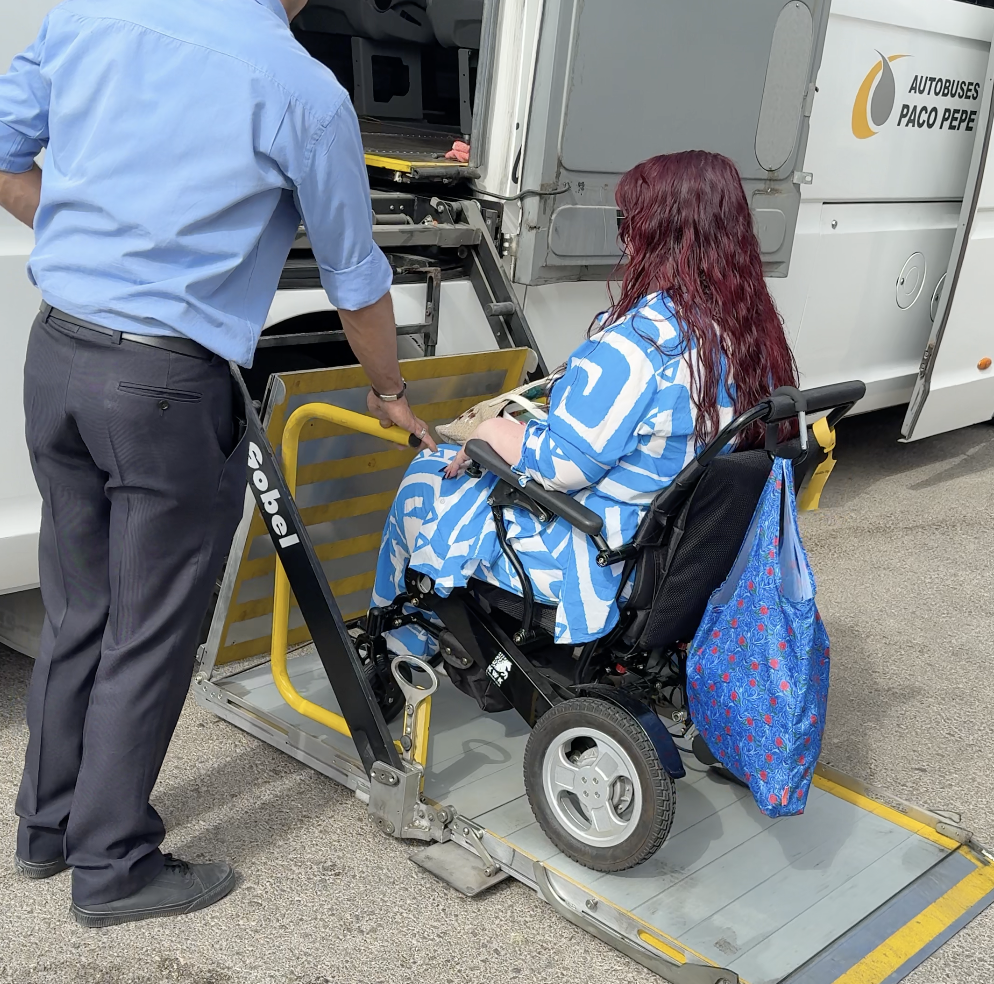
Some ports (like Zeebrugge and Le Havre) require shuttle buses due to being working ports. These are generally accessible, either with a floor-level ramp or a lift. I personally hate using lifts as an ambulatory wheelchair user as I know I can just walk up the steps, but my chair would still have to use the lift, so I may as well stay on it and then I can say it works for my chair and my size.
Accessibility Tips for Iona & Arvia
Learn the Lift Colours
I really do tell everyone this, learn your lifts. Learn if you’re front, middle or back and learn the colours which are on every staircase.
- Blue = front
- Grey/White = middle
- Red = back
Using the wrong lifts means battling through endless corridors, room service trays, and housekeeping carts. So if you’re at the wrong lifts, head to a public deck like 6/7/8 and cut across.
Decks 6-8 are wide open areas with lots of space, you then find the lifts that will take you straight to your room and you’ll get there without any frustrations.

Stick to the Middle
Another tip for the lifts, especially on the Iona is stick to the middle of them and let people go around you. Even on the Arvia, if you’re in a large wheelchair or scooter, even though the lifts are a big bigger on the Arvia, it’s not worth getting stuck in front of people, I for one hate it! Stick to the middle and just tell people that it’s easier for you. I’ve found across 4 cruises everyone is always so friendly and understanding.
Accessible Cabins on Iona & Arvia
The cabins are spacious, with automated doors to the room, bathroom, and balcony. At first, these were frustrating as an ambulatory users, trying to manually open them is painful. But by the second cruise, I appreciated them for what they are: accessible, well-thought-out, and independence-boosting.
- Balconies have a slight slope, and the dressing table is on that incline. Not ideal. It caused discomfort and made the chair at the desk feel unusable.
- Corner balconies were brilliant. We had three cabins next to each other and the stewards opened up the balconies to create one huge space. Perfect for group cruising.
@georginagrogan_ Adpr – I’m on a cruise with @Limitless Travel who book and organise guided group holidays for disabled people! Here’s a room tour of the accessible cabin that they booked for me on the P&O Arvia! They handle everything, it’s such a great, stress-free way to travel! Keep watching for more! Room 12629 P&O Arvia #wheelchairuser #LimitlessCruises #LimitlessTravel #AccessibleTravel #WheelchairUser #POCruises #Arvia #CabinTour #disabledtiktok #ambulatorywheelchairuser ♬ original sound – Georgina Grogan
Bathrooms are excellent. Even as a size 28 woman, I found the shower seat solid, the layout spacious, and the toilet had plenty of rails.
The beds are some of the best we’ve ever slept on, and the rooms are silent, even next to lifts. The automated doors took getting used to, but they add a real sense of independence.
The doorbell and phone ringing is something to get used to, as with the rooms being for every type of disability, the rooms will flash, sound an alarm, and vibrate to let you know if someone is ringing or knocking. It’s quite alarming so I recommend you push it when you first get on so you know what to expect.
Accessibility Around the Ship

All public accessible toilets have automated doors, and they work well. Some slopes around the ship can be steep, especially for self-propelling users, but they’re manageable especially when you clock where they are and are prepared.
You can access everything, including:
- Headliners Theatre (wheelchair spaces front and back)
- Ocean Studios (wheelchair spaces)
- Beachcomber Pool (bookable pool hoist)
The Oasis Spa is tricky. Locker access is tight, there’s no pool hoist, and the layout makes transfers hard. Staff are helpful, and I made it work by leaving my chair in the relaxation room, but full-time wheelchair users will struggle.
Accessible Cruising on P&O Iona & Arvia
Once you understand the layout, lift system, and deck logic, cruising on Iona or Arvia as a disabled traveller becomes genuinely enjoyable. I think they’re both fantastic wheelchair accessible cruise ships.
I feel free and independent on these ships, something I rarely feel elsewhere. I can go wherever I want without asking for help. That’s huge!
If you’re a disabled cruiser planning your first trip with P&O, here are my tips:
- Learn the lift colours early
- Choose midship if you can for shorter travel times (but expect a longer wait during busy periods)
- Use open decks to switch to the right lifts
- Book assistance for embarkation and disembarkation
- Research your cabin’s layout – corner balconies are worth it for big groups or scenic cruises
Let me know your experiences in the comments, especially if you’ve cruised on Arvia or Iona as a disabled traveller.
